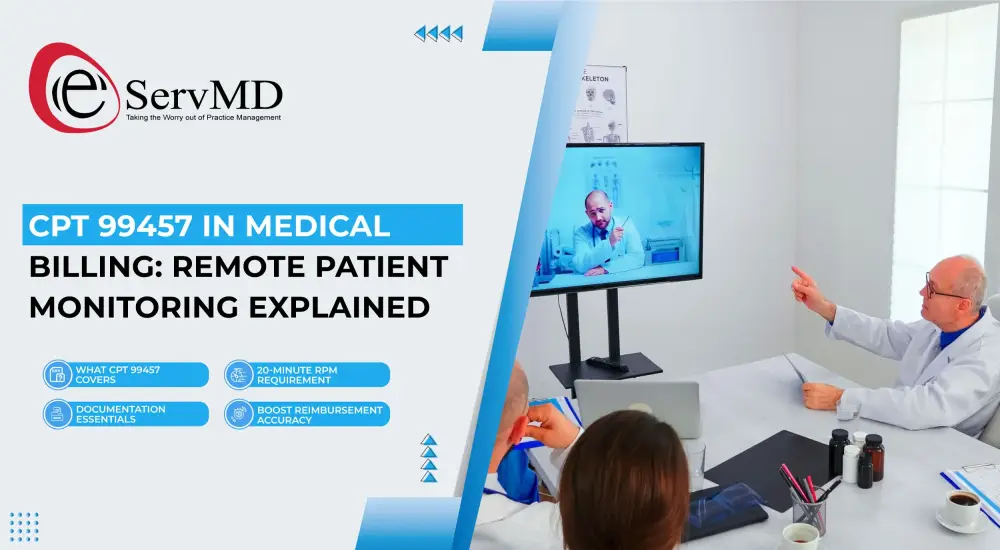
Remote Patient Monitoring (RPM) continues to grow rapidly in the U.S., especially for chronic care patients who need ongoing follow-up outside the clinic. One of the most important RPM codes is CPT 99457, and understanding how it works is essential for accurate billing, stronger compliance, and higher reimbursement. In this guide, you’ll learn everything about CPT 99457 in medical billing, including documentation rules, Medicare requirements, real billing experience, and how to correctly track RPM management time.
Just like other detailed CPT code guides such as our explanation of high complexity hospital care in CPT 99223 in medical billing this guide is structured to help both providers and billers avoid costly claim denials and stay compliant with 2026 RPM billing rules.
What Is CPT 99457?
CPT 99457 represents 20 minutes of interactive RPM management time performed by clinical staff or a physician during a calendar month. It’s one of the most frequently billed RPM codes alongside 99454 and 99458, and it focuses on care management, not data transmission.
This code is different from other preventive or evaluation codes like the CPT 99406 smoking cessation code or age-based preventive visits like CPT 99395 preventive visit. CPT 99457 specifically covers clinical time spent engaging the patient, assessing RPM data, and making management decisions.
How CPT 99457 Differs from 99454 and 99458
-
99454 → Device supply + data transmission
-
99457 → First 20 minutes of RPM management
-
99458 → Each additional 20 minutes
If your practice routinely bills E/M codes like CPT 99204 or CPT 99203, think of 99457 as a monthly management service rather than a face to face clinical encounter.
Billing Requirements for CPT 99457
To bill CPT 99457 in medical billing, your RPM service must meet these core requirements:
1. 20 Minutes of Interactive Communication
This is the most important requirement.
The provider or clinical staff must complete 20 minutes of patient management, which can include:
-
Reviewing RPM data
-
Making treatment adjustments
-
Calling, video chatting, or messaging the patient
-
Coordinating care
This is similar to how time requirements matter for other time based codes like 99215 or 99205, which you can learn more about here:
2. Clinical Staff vs Physician Time
Medicare allows clinical staff time under general supervision one reason RPM has become widely adopted in chronic care management.
3. Real-Time or Interactive Communication
You must have at least one interactive (two-way) patient communication within the month.
This can include:
-
Phone calls
-
Video calls
-
Two-way patient portal messaging
4. Eligible Patient Conditions
RPM is covered for conditions such as:
-
Hypertension
-
Diabetes
-
CHF
-
COPD
-
Post-surgical monitoring
-
Medication titration
But the final eligibility depends on medical necessity similar to how necessity is required for codes like CPT 99212.
Documentation Needed to Support CPT 99457
Accurate documentation is critical. Missing documents are the #1 reason for RPM claim denials.
You must document:
1. Proof of 20 Minutes
Record:
-
Time spent
-
Activities performed
-
Date of service
2. Type of Communication
Specify whether communication was:
-
Phone
-
Video
-
Portal messaging
3. Patient Consent
Medicare requires written or verbal consent once per year.
4. RPM Device Data Logs
You must show that:
-
Data was received
-
Data was reviewed
-
Data influenced care decisions
This mirrors the documentation style used for codes like CPT 99214 and CPT 99213.
Reimbursement for CPT 99457
Medicare Reimbursement (National Average 2026)
-
CPT 99457: ~$48 – $52 per month
Commercial payers often reimburse 10–25% more, depending on the state.
Billing Frequency
You can bill once per month, regardless of number of patient interactions.
For comparison, preventive codes like CPT 99396 or CPT 99397 are billed annually, not monthly.
Common Mistakes to Avoid
1. Missing Interactive Communication
Reviewing RPM data alone does NOT count.
2. Not Meeting 20-Minute RPM Rule
The 20-minute requirement is strict.
Many practices mistakenly log 18 or 19 minutes, leading to denials.
3. Incorrect Use of 99457 + 99458
You can bill:
-
99457 → first 20 minutes
-
99458 → each additional 20 minutes
But cannot bill 99458 alone.
4. Missing Patient Consent
A common mistake for new RPM programs.
Real Billing Experience: What Actually Happens in RPM Claims
After managing RPM billing for several cardiology and primary care practices, here’s what we’ve consistently seen:
1. Providers Underestimate Time
Doctors often think they spent 20–30 minutes per patient but actually logged only 8–12 minutes.
This often leads to downcoding similar to the issues many practices face with codes like 99221 or 99222.
2. Incorrect Time Tracking Tools
Some EHRs don’t automatically log:
-
Call duration
-
Portal messaging timestamps
-
Data review time
This causes Medicare audits due to inconsistent documentation.
3. Common Provider Mistake
Providers often assume that reading RPM data alone is billable.
But CPT 99457 requires interactive communication, so pure monitoring does not qualify.
4. A Real Case Example
One client’s RPM claims were repeatedly denied because their staff spent 20–25 minutes per month but failed to document the interactive communication.
We corrected the workflow, added communication notes, and approval rates jumped from 62% to 98% within one month.
5. Misunderstanding Monthly Billing
Some practices bill twice a month, which always gets denied because CPT 99457 is monthly, not encounter-based.
How eServMD Helps Improve Your RPM Billing
eServMD supports RPM programs with:
✔ Automated Time Tracking
No more guessing minutes our system logs everything automatically.
✔ Documentation Review
We ensure your notes meet CPT 99457 documentation rules and Medicare RPM guidelines.
✔ Faster Claims + Fewer Denials
Automation reduces claim denials linked to missing time, missing patient consent, or incomplete notes.
✔ Real Compliance Monitoring
We ensure compliance with:
-
Time requirements
-
Communication rules
-
Medicare guidelines
-
RPM data validation
Ready to streamline your RPM billing?
👉 Schedule a Demo
FAQs – CPT 99457 in medical billing
1. What is CPT 99457 in medical billing?
CPT 99457 in medical billing is used for remote patient monitoring (RPM) management time, covering at least 20 minutes of interactive communication per month.
2. How many minutes are required to bill CPT 99457?
To bill CPT 99457 in medical billing, providers must document 20 minutes of clinical staff or provider time related to RPM management.
3. Can CPT 99457 and 99458 be billed together?
Yes, CPT 99457 and 99458 can be billed together, but 99458 is only for additional RPM time after the first 20 minutes.
4. Who is allowed to bill CPT 99457?
Qualified health professionals and supervised clinical staff can bill CPT 99457, following RPM program rules and documentation requirements.
5. What documentation is needed for CPT 99457 reimbursement?
To get paid for CPT 99457, Medicare requires documentation of time spent, communication type, device data review, and patient consent.